Classic Mustang · Restoration Cost Guide
Classic Mustang restoration cost: $20,000–$300,000
What the first quote doesn't include
By Dorian — owner, restorer, no parts to sell. Every line item on the estimator, what drives it, and what LA shops actually charge. Costs reflect 2026 market data.
Pricing reviewed by Dorian · April 2026
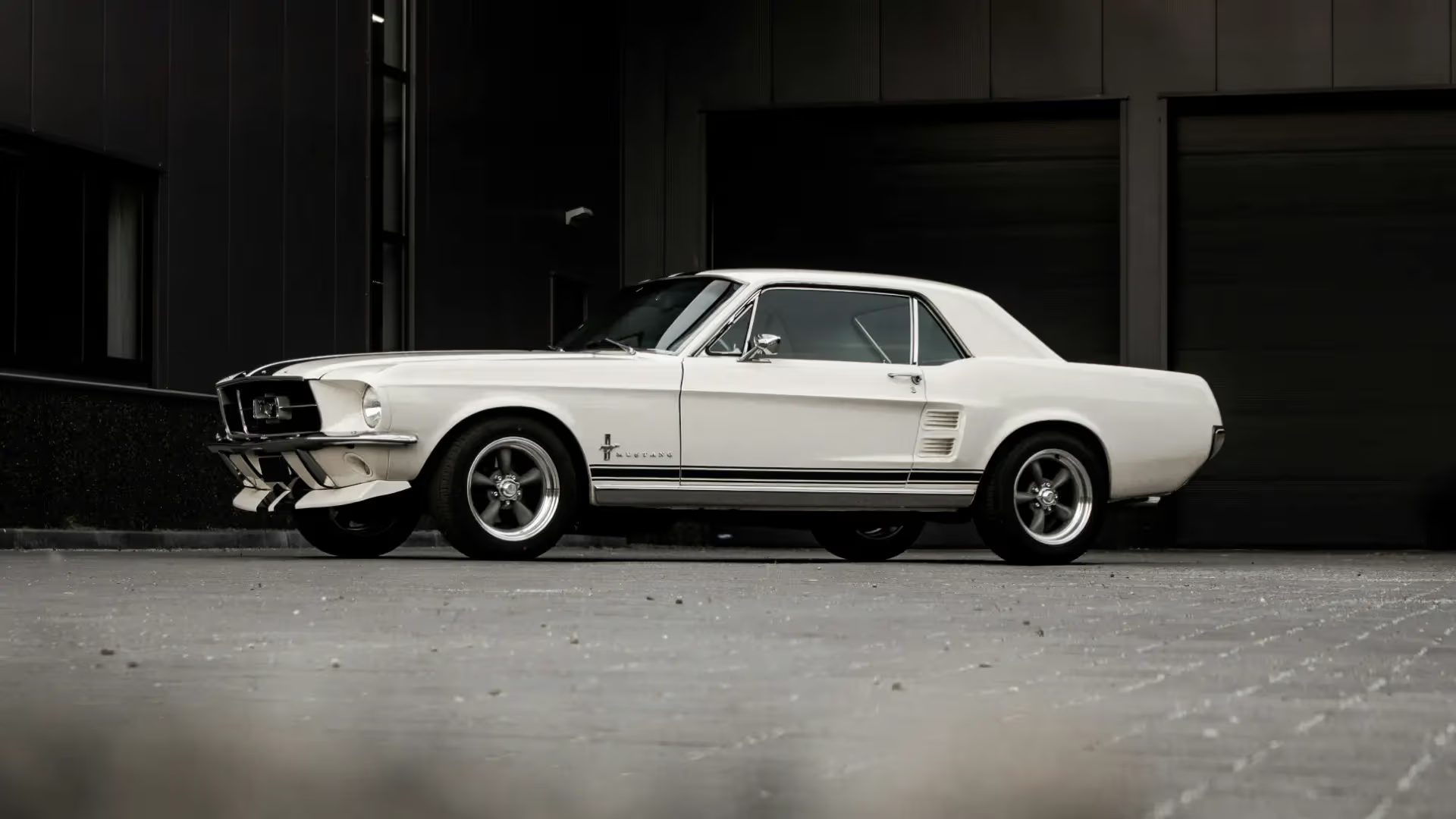
Owner's experience · Original family car since 1967
The first shop I called gave me a quote of $125,000. I remember thinking: okay, that's the job. It wasn't. That was show quality — a rotisserie restoration from the ground up. What I was actually trying to figure out, at that point, was something much simpler: where do I even start?
My family has owned this car since 1967. My dad bought it new. He drove my mom to the church in it on their wedding day, drove on their honeymoon in it, drove my brother home from the hospital in it. When I finally decided to do the restoration right — in 2010, after the car had been sitting since 1993 — I started calling shops.
What surprised me most wasn't the quote. It was what I didn't know before I made the call. The internet has plenty of information about Mustang restoration. It has almost no education. There are books that tell you how to rebuild the car yourself. There are forums full of parts talk. What there isn't is someone telling you: before you spend a dollar, you need to decide what kind of car you're building. Show car, driver, restomod, investment — each one is a completely different project with a completely different budget. And if you're not already a mechanic, you're starting this conversation at a serious disadvantage.
That's what this guide is for.
— Dorian, owner & restorer
2026 Data · I ran my own car through the estimator
My 1967 Mustang: inline six, coupe, poor condition (sitting since 1993), show-quality scope. The estimator puts the project at $112,000–$185,000 with contingency. The first shop's $125,000 quote covered bodywork only — it didn't include engine rebuild, transmission, suspension, interior, or assembly. The estimator's category breakdown is the tool I wish I'd had before that first call.
The parts market for classic Mustangs is genuinely healthy — aftermarket parts are not where the money goes. It's the skilled labor hours. Finding people who can do unibody fabrication, correct paint, and electrical work on a 60-year-old car is getting harder, not easier. That's the cost driver most articles don't emphasize.
Year Range
Body Style
Current Condition
Restoration Scope
Purchase Price (optional)
We'll calculate your all-in cost vs. current Hagerty market value.
Have fresh paint or a rebuilt engine?
0 of 4 — pick a Year Range
The PonyRevival cost estimator splits a classic Mustang restoration into 9 categories. These are the same buckets shops use when they break down a quote — paint, rust, engine, transmission, suspension, interior, electrical, brakes, and the catch-all assembly & misc that consumes the back half of every project.
Below: the full range across all four scope tiers (driver to concours), what actually drives the cost, and what to expect if you're getting quotes in Los Angeles. National averages assume ~$125/hr shop labor; LA runs 30–40% higher.
Category · Full range
Paint & Bodywork
$4,000 — $60,000
Paint is the most visible category — and the one most likely to get butchered by a body shop chasing margin.
Most of the bill is prep. Sanding, body filler, panel alignment, masking, primer. Materials are 10–15% of the total; everything else is labor at $75–$125/hr nationally, or $150–$175/hr at LA premium shops.
A driver-quality respray ($4–8K) gets you "looks great from ten feet" — modern basecoat/clearcoat over lightly prepped panels, trim taped off rather than removed. A concours-grade finish ($35–60K) is full disassembly, color-correct DuPont, jambs and underbody painted, every panel gap dialed in.
The "$2K Maaco special" exists. It is a $2K Maaco special.
Active modifier: Convertible bodies add ~10% — additional structural panels, weatherstrip channels, and masking around a folded top is its own specialty.
LA reality: LA shops bill $75–$125/hr for paint vs. $50–$100 nationally. A $4,000 driver paint job nationally runs $5,500–$7,000 in LA.
Scope moves this number 8×, from driver respray to concours finish. Plug in your build to see the exact range.
Run your numbers →Category · Full range
Rust Repair
$2,000 — $40,000
There's no flat rate, no book time, just you and a pile of metal dust where your floor pans used to be.
Rust isn't priced like brake pads. Surface rust in the trunk floor: a few hundred bucks. Floor pan sections: $1,500–$3,500. Major structural — full floor, torque boxes, frame rails, cowl: $8,000–$16,000. Complete underbody on a rust-heavy car: $16,000–$35,000+.
Specialized metal fabrication labor commands $130–$200/hr because most general body shops can't do unibody welding. Parts are cheap (NPD floor pans run $400–$800); the labor to cut, fit, and weld them in is where the money goes.
Active modifier: Poor starting condition adds 35% to rust costs. Convertible adds another 10%. A rust-free California car (good condition) saves 35%.
LA reality: A clean SoCal car was rust-free for 50 years. An Ohio import probably needs everything. Geographic bias bites hard here.
Your car's condition rating is the biggest variable in this category. Set it in the estimator and see the swing.
Run your numbers →Category · Full range
Engine Rebuild
$4,500 — $25,000
The number that makes grown men wince.
A basic stock 289/302 rebuild — factory reliability, 180–250 HP — runs $4,500–$8,500. Figure 30–50 labor hours at $110–$165/hr nationally. Performance rebuild with upgraded internals and 300–400 HP: $8,500–$14K. Full competition build with blueprinting and dyno tuning: $14,000–$25,000.
Cost driver: machine shop hourly rates and core condition. A "good core" engine that looks salvageable often isn't — cracked bores, walked main caps, broken bolts in the block. Discovery during teardown is what blows up the budget.
LA reality: At $110–$165/hr LA machine shop labor, a performance rebuild's labor alone runs $4,400–$9,900 before you've bought a single piston.
Stock reliability or 400 HP? Scope and condition together drive this number. Get your Low/Mid/High.
Run your numbers →Category · Full range
Transmission
$800 — $7,000
Your '67's C4 starts slipping into neutral on the 405. Welcome to transmission costs.
Stock C4 automatic rebuild: $1,200–$2,500. Toploader 4-speed: $2,500–$4,500 (specialized labor — most shops send these out, adding markup). T5 5-speed overdrive swap: $3,500–$6,000 — the most common upgrade owners actually choose. AOD or 4R70W swap: $4,000–$7,000.
The hidden cost is "while we're in there." Clutch, flywheel, mounts, driveshaft, crossmember, speedometer cable. Plan for 40–60% rebuild and 40–60% supporting work.
Stock rebuild, overdrive swap, or full conversion — each is a different project cost. See how transmission scope changes your total.
Run your numbers →Category · Full range
Suspension
$1,100 — $25,000
Vintage Mustang suspension components have the structural integrity of overcooked pasta.
Stock refresh — shocks, bushings, ball joints, idler arm, control arms — runs $2,000–$3,500. Performance package with sway bars, lowering springs, KYB shocks: $3,500–$5,500. Full coilover system that makes the car handle like it's from this century: $5,500–$12,000+. Rack-and-pinion conversion: add $3,000.
Concours numbers explode because date-coded shocks, NOS bushings, and correct stamp markings command collector pricing — not because the work is harder.
LA reality: LA suspension labor runs $150/hr standard. The 20% premium is mostly rent and insurance, not specialized skill.
Stock refresh to full coilovers is a $3,500–$22,500 spread. Find your tier in the estimator.
Run your numbers →Category · Full range
Interior
$4,000 — $70,000
Replacing a cracked dash pad turns into a $15K interior restoration. Ask me how I know.
This is usually the single largest line item on the estimator. Standard refresh — carpet, seat covers, dash pad, door panels — runs $7,800–$16,500. Full restoration with new foam, headliner, console, and hardware: $14,200–$32,000. Concours interior with correct grain vinyl, date-coded hardware, and NOS trim: $25,000–$70,000.
The hidden line item is the headliner. Every shop charges premium because installing a 6-foot sheet of fabric-backed foam over a windshield-out dash is its own art form. Spray adhesive makes everything permanently sticky and the foam fights you like a wet sail.
LA reality: $100–$165/hr at LA interior shops. The high end is justified by upholstery skill — there are maybe a dozen people in LA who can stitch a correct seat cover.
Interior is usually the largest single line item. Run your scope and body style to see your Low/Mid/High.
Run your numbers →Category · Full range
Electrical System
$500 — $15,000
A $40 part can require $800 in labor because it's buried behind a dashboard Ford assembled using spite and tiny screws.
Labor costs 2–3× parts cost in this category. Alternator swap: $400–$1,000. Wiring harness (partial replacement): $1,000–$2,100. Full rewire with modern fuse panel: $3,000–$5,500. Modern upgrades — 3G alternator, LED conversion, electronic ignition: add $1,500–$3,000.
Original Mustang harnesses are 50 years old, brittle, and often patched by previous owners using methods that suggest open hostility toward electricity. Diagnostic time alone can run 6–10 hours before any actual repair.
LA reality: $120–$165/hr for specialty electrical work in LA. Good auto-electric shops are scarce — half the labor cost is the scarcity premium.
Discovery costs are what blow up this category. Get a budget number before you pull the dash.
Run your numbers →Category · Full range
Brake System
$500 — $9,000
Drum brakes designed during the Kennedy administration have opinions about emergency braking. Specifically, the opinion that "emergency" is negotiable.
Stock drum brake rebuild: $500–$1,500. Front disc conversion (Granada or aftermarket): $1,960–$4,000. Power booster + dual-circuit master cylinder: add $800–$1,500. Full four-wheel disc with proportioning valve and braided lines: $6,680–$12,500.
Disc conversion is the single highest-ROI safety upgrade you can make on a classic Mustang. Skip it and you skip stopping in modern traffic.
Disc conversion adds safety and a specific dollar amount to your total. See how brakes factor into your full estimate.
Run your numbers →Category · Full range
Assembly & Misc
$3,000 — $60,000
The category nobody quotes upfront. The 'while we're in there' tax.
Final assembly — putting all the restored parts back together — is 200–500 hours on a frame-off build. Trim, glass, weatherstripping, hardware, paint markings, decals, fluids, filters, fasteners. The gap between "all the major work is done" and "you can drive it to a show."
Plan for 15–25% of the total project cost in this category. It's the line item that makes your $60K project finish at $75K.
Active modifier: Convertible adds 10% — top mechanism, top installation, additional weatherstripping channels.
This is the category most shops leave out of the first quote. The estimator includes it. See your real total.
Run your numbers →Year-specific estimators
Each year page pre-selects the right era defaults. The four eras have meaningfully different cost profiles — parts availability, specialist supply, and market values all shift.
1964½–1966 · Early first gen
The original narrow-body platform. Early cars command a premium for correct stampings and date-coded parts — NOS hardware is scarce and collector-priced. Parts supply is otherwise deep for mechanical components. Engine bay constraints rule out most big-block swaps without fabrication.
1967–1968 · Widebody sweet spot
Ford widened the body 2.7 inches, created room for a 390 FE big block, and set the classic Mustang silhouette. The aftermarket for this era is the deepest of any classic Mustang — CJ Pony Parts, NPD, and Scott Drake stock virtually everything in reproduction. Specialists are plentiful and parts ship overnight.
1969–1970 · SportsRoof era
The longest, lowest, and most aggressive of the first-generation cars. SportsRoof fastbacks carry a consistent premium on BaT — driver-quality examples routinely sell above restoration cost. Boss 302 and Boss 429 provenance adds significant cost at every scope tier. The 1970 revised the front end but shares the same platform and cost structure as the 1969.
1971–1973 · Full redesign
Ford stretched the 1971 onto a 109-inch wheelbase — four inches longer than the 1969–1970 cars, and about 600 pounds heavier. Almost no body panels carry over from earlier years. The aftermarket for 1971–1973 is narrower: some trim pieces haven't been reproduced since the 1990s, sourcing timelines run longer, and fewer shops specialize in this platform. Budget 10–20% more for sourcing on a trim-correct restoration. Market values run lower than the classic-era cars except for the Boss 351, which is in its own collector tier.
Common questions
Mustang restoration cost FAQ
How do I know if a Mustang is worth restoring or should I just find a better car?
The math is straightforward once you have numbers. Run the estimator for your specific car — year, body style, condition, and scope. Then compare the total project cost to: (1) what the finished car is worth in the market at that scope level, and (2) the asking price for a cleaner starting car. If the restoration cost plus the purchase price of the project car significantly exceeds those benchmarks, the arithmetic says find a better car. For a family heirloom or a numbers-matching car with documented history, the math doesn't always drive the decision — but you should still run it with your eyes open.
What's the difference between a driver-quality restoration and a restomod — and does it matter for cost?
Driver quality is a frame-on restoration that makes the car reliable and presentable — $20,000–$80,000. You are fixing what's broken, restoring what's deteriorated, and driving the result. A restomod goes further: upgraded engine, modern suspension, better brakes, fresh interior with modern comforts — $30,000–$200,000. Scope tier is the single largest cost variable because it multiplies every category simultaneously. A driver-quality rust job is $2,000–$5,000. A concours rust job on the same physical rust is $15,000–$40,000. Before you call a shop, decide which car you are building.
Should I buy a numbers-matching car or does it not matter if I'm doing a restomod?
For a restomod, numbers-matching is mostly irrelevant to cost — you are modifying the car anyway, and the market doesn't pay a premium for a restomod built on a matching-numbers car. For a show or concours build, numbers-matching is the difference between a $45,000 car and a $100,000 car at auction. For a driver build, numbers-matching adds to purchase and resale value, but it doesn't change restoration cost — you restore the same components either way.
How much should I budget for surprises — and what are the most common surprise costs?
Budget 15–25% above your subtotal. The PonyRevival estimator applies this contingency by scope tier: 15% for driver and restomod, 20% for show, 25% for concours. The most common surprises: rust that's worse than the visual inspection suggests once the car is stripped ($3,000–$8,000 additional), an engine that "ran fine" until the machine shop hot-tanked it and found cracks or walked mains ($1,500–$4,000 additional), and final assembly taking 30–50% longer than quoted because restored components need fitting and adjustment. The single biggest lesson: the first quote is never the final scope.
I got a shop quote — is it reasonable, or am I being gouged?
Run the PonyRevival estimator, then compare your shop's category breakdown line by line. If line items are within the estimator's Mid-to-High range at your scope tier, the quote is in market. If a single category is dramatically above the High estimate, ask the shop to justify the labor hours specifically. The two categories most commonly over-quoted by shops who aren't Mustang specialists: rust repair (they estimate conservatively because they're guessing at hidden damage) and electrical (same reason). The two most commonly under-quoted: assembly and the "while we're in there" work that accumulates as the project opens up.
How long does a classic Mustang restoration take?
A driver-quality restoration takes 800–1,200 hours of shop time, which translates to 12–24 months at a busy shop working on multiple cars. A concours restoration runs 4,000–5,000+ hours — 3–5 years is realistic. The timeline expands with rust severity, parts sourcing delays, and scope changes mid-project. The single most common cause of timeline blowout: discovering structural rust during teardown that was not visible before disassembly.
How do I find a good Mustang restoration shop?
Ask for references from completed restorations — not in-progress work — and visit those cars in person if possible. A shop that specializes in classic Mustangs will have opinions about specific vendors (CJ Pony Parts, NPD, Scott Drake), know what makes each era different, and quote by category rather than giving a single lump-sum number. Avoid shops that cannot break down their estimate by category. If they cannot itemize, they are guessing.
Category deep-dives
Each category guide goes deeper on a single line item — what's actually driving the cost, what shops charge, and where you have leverage.
Paint & Bodywork
Paint & Bodywork Cost Guide
$4,000–$60,000. The respray is the smallest part of the bill — prep is where the money goes.
Rust Repair
Rust Repair Cost Guide
$2,000–$40,000. No flat rate — surface rust and structural repair are different planets.
Engine
Engine Rebuild Cost Guide
$4,500–$25,000. Stock 289/302 vs. performance build vs. competition — what the machine shop charges.
Transmission
Transmission Rebuild Cost Guide
$800–$7,000. C4 rebuild, Toploader, T5 overdrive swap, or AOD — each is a different project.
Suspension
Suspension Cost Guide
$1,100–$25,000. Stock geometry refresh to full coilovers — the decision that determines your budget.
Interior
Interior Restoration Cost Guide
$4,000–$70,000. Usually the single largest line item. The headliner, the harness, the DIY split.
Body Panels
Body Panel Replacement Cost Guide
Reproduction vs. NOS vs. used — what each panel costs and where the labor bill actually goes.
Brake System
Brake System Cost Guide
$500–$9,000. Drum rebuild vs. disc conversion — the one upgrade every driven car should have.
Electrical System
Electrical System Cost Guide
$500–$15,000. Spot repair vs. full harness — why 60-year-old wiring always surprises.
Assembly & Misc
Assembly & Misc Cost Guide
$3,000–$60,000. The catch-all — chrome, trim, glass, weatherstripping, startup, and final assembly.
All Guides
Browse the full guide library →
Parts decisions, pre-purchase inspection, first-timer lessons, and all cost categories.
Run your numbers
Plug in your year, body, condition, and scope — get a full Low/Mid/High breakdown across all 9 categories.
Open the estimator →All ranges reflect 2026 market data based on first-person research and direct shop quotes sourced in the Los Angeles market. National averages assume ~$125/hr labor; CA/LA rates run 30–40% higher. PonyRevival earns a commission on affiliate purchases at no cost to you. We have no parts to sell — these estimates are not influenced by affiliate relationships.